
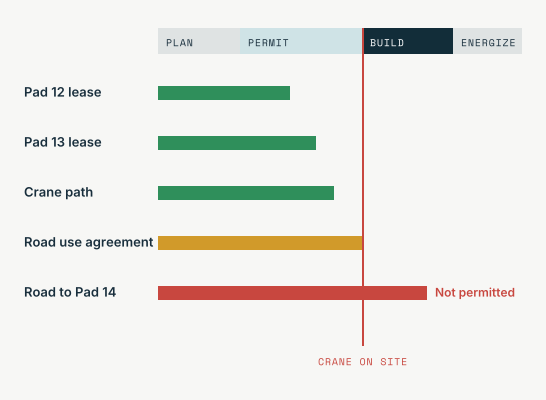
The crane is on rent. The road to the next pad isn’t permitted.
A main crane is the most expensive thing on a wind project to leave waiting. REALMS shows which pads it can reach, and which it cannot yet.
Everyone knew something. Nobody knew all of it.
Illustrative scenario.
Three weeks before
The permitting lead knows the road use agreement for the next haul route is not signed. It is in her inbox.
The day the crane finishes
One turbine is up. The plan says the next pad is ready for deliveries.
The week after
The crane sits. Components cannot be delivered to the next pad, and the crane is paid for by the day.
One late answer, paid for four ways.
The later you find out, the more it costs.
Three weeks early
A phone call and a change of sequence.
The week before
A scramble, and favours called in.
On the day
A crew and its equipment standing by.
After
The window, the relationship, and the argument about whose fault it was.
Schedule
Days lost first, then the window that was behind them.
Money
A crew and its equipment on standby. You know what a day of that costs you.
Reputation
With the contractor, the people whose land it is, and the board.
Approvals
Rushed work is how conditions get missed and approvals get put at risk.
The information existed. It was in different hands.
The people working the approval knew
It was a line in a tracker built for their own team.
Construction had the schedule
Built from planned dates, not from what was cleared on the ground.
Nobody had both
No single record tied the road use agreement to the pads at the end of that road.
Land
Its own tracker, kept up to date.
Regulatory & permitting
Road use agreement: not signed.
Environment
Its own tracker, kept up to date.
Engineering & utilities
Its own tracker, kept up to date.
Nothing ties an approval to the ground it holds up.
Planning
Builds the schedule from planned dates.
Construction
Mobilizes against the schedule.
Crews in the field
Find out when they get there.
Same project. Same problem. Known three weeks earlier.
Three weeks before
The road use agreement shows as Forecast Late, and the four pads behind it turn with it.
The decision
The construction manager re-orders the erection sequence so the crane moves to pads it can reach.
The day the crane finishes
It moves straight to the next pad. The agreement closes while it works elsewhere.
Land
Its status lands on the location.
Regulatory & permitting
Road use agreement: Forecast Late.
Environment
Its status lands on the location.
Engineering & utilities
Its status lands on the location.
Every approval tied to the ground it holds.
Planning
Schedules the ground that is clear.
Construction
Moves crews to work that is ready.
Crews in the field
See what they can work today.
One record. A different answer for each person who is accountable.
Executives
One readiness answer for the site, the reason behind it, and what is forecast to be late.
Construction managers
Which packages can go this week, and what is holding the rest.
Land & permitting leads
Every approval with an owner, a next step and a date, and a record of what was waiting on whom.
Project controls
A forecast date for every location, and a record of when each one was released to construction.
Indigenous & stakeholder relations
Every commitment on the ground it applies to, where crews will see it.
Built to sit inside your environment.
Your cloud or ours
Run REALMS in your own Azure tenant, or have us host it.
Your sign-in
Staff sign in with their Microsoft 365 accounts. No new passwords.
Your documents
Documents stay in your SharePoint.
Your data
A standard PostgreSQL database, open to your reporting tools through SQL or the REALMS API.
Your maps
Your ArcGIS layers on the same map as the project.
See REALMS on your site.
Bring the turbine layout and the crane schedule. We will show you which pads are at risk.